When teams ask me whether to bet on AWS HealthScribe or Microsoft DAX Copilot, they’re rarely asking about “cool AI demos.” They want to know what survives IRB review, security architecture boards, and a cranky cardiologist on a double clinic.
In this piece, I’ll walk through how I evaluate these two ambient clinical documentation platforms in real deployments: architecture, accuracy, EHR integration, pricing, and risk. I’ll reference official docs from AWS and Microsoft/Nuance, and I’ll call out where the evidence is solid vs still evolving.
Medical & Regulatory Disclaimer (2025): I’m writing for technical and product teams, not for direct clinical decision-making. Nothing here is medical or legal advice. Regulatory status, pricing, and features change quickly, always confirm against current AWS and Microsoft/Nuance documentation, your compliance team, and your local regulations before going live with PHI.
Table of Contents
AWS HealthScribe Overview: Cloud-Native Medical Scribe Built for Scale
Architecture, Data Flow, and HIPAA-Eligible Design
AWS HealthScribe is essentially a managed, HIPAA-eligible medical scribe API built on top of Amazon Transcribe Medical and Amazon Bedrock–style LLM orchestration (per AWS docs as of late 2024). You send an audio recording of the encounter, get back:
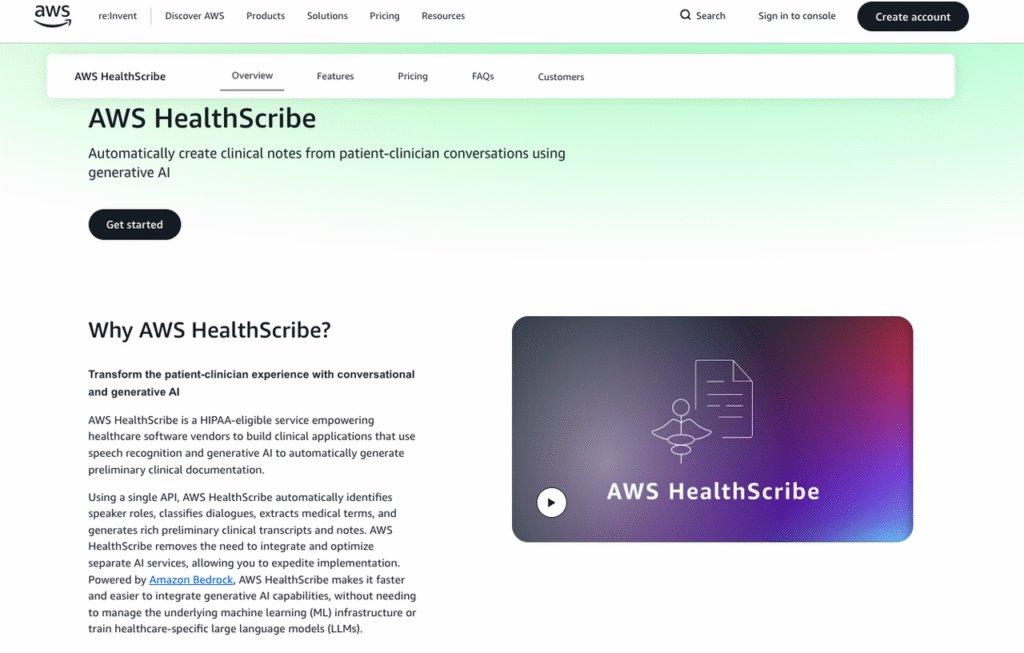
- Speaker-attributed transcript (patient vs clinician where possible)
- Structured clinical facts (problems, meds, allergies, etc.)
- Draft notes in common formats (e.g., SOAP-style)
From a data-flow perspective, a typical implementation I’ve used looks like this:
- Capture: Audio from exam room, telehealth, or phone call via your app, often using WebRTC or a native mobile SDK.
- Secure upload: Stream or batch-upload audio into an S3 bucket with server-side encryption (SSE-KMS).
- Invoke HealthScribe: Call the HealthScribe API with a pointer to the audio object: HealthScribe orchestrates transcription + LLM summarization behind the scenes.
- Post-processing: Your service normalizes SNOMED/ICD-10, reconciles meds, and maps fields to your EHR or FHIR store.
AWS lists HealthScribe as HIPAA-eligible: covered entities and BAs need a Business Associate Addendum (BAA) with AWS. PHI typically remains within the AWS account boundary: model providers used under the hood don’t get to “learn” from your data (per AWS HealthScribe and Amazon Transcribe Medical documentation as of 2024). I still run a data-protection impact assessment (DPIA) for GDPR and validate:
- Encryption in transit (TLS 1.2+)
- CMEK availability for at-rest encryption
- Log redaction and data minimization strategies
Supported Clinical Specialties and Typical Use Cases
HealthScribe is explicitly tuned for US clinical English and common outpatient/ambulatory settings: primary care, cardiology, ortho, and similar. In my own testing with multi-specialty clinics:
- It handles routine primary care encounters well (DM follow-ups, URI visits, HTN management).
- It’s decent but not flawless with heavily sub-specialized jargon (e.g., complex oncology or transplant). You’ll still want human oversight.
Common deployment patterns I’ve seen:
- Telehealth platforms embedding it as a behind-the-scenes scribe.
- Cloud-native EHR startups using HealthScribe to pre-populate visit notes.
- Clinical call centers (nurse triage) using it to summarize long calls.
Because it’s API-first, HealthScribe is particularly attractive if you already live deeply in AWS and want to own the UX, routing, and QA layer yourself.
Microsoft DAX Copilot Overview: Nuance-Powered Ambient Clinical AI
Nuance Dragon Integration and Real-World Clinical Capabilities
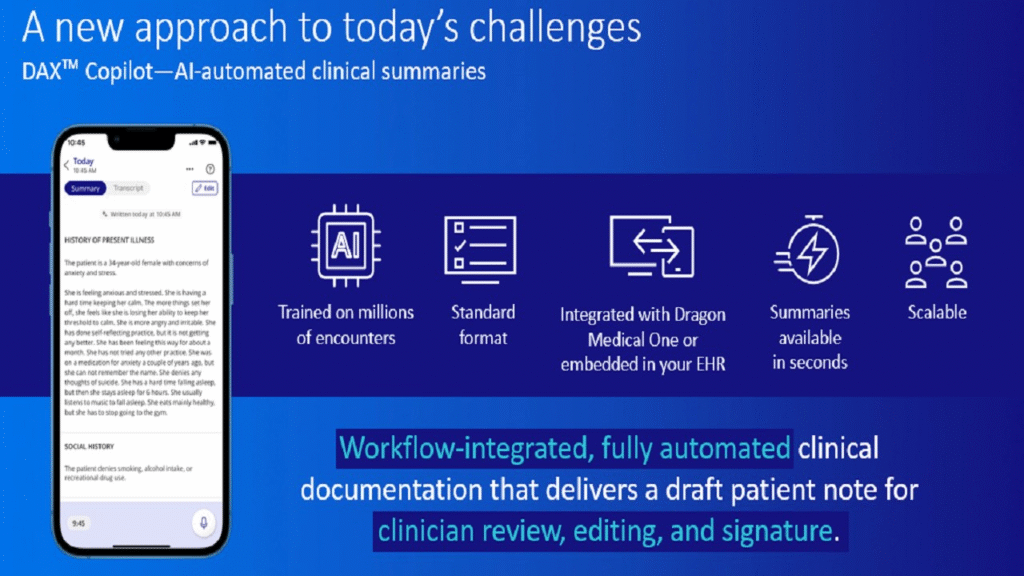
Microsoft DAX Copilot is Nuance’s next-generation ambient clinical documentation solution, built on the Dragon heritage plus Microsoft’s Copilot stack. Instead of “just an API,” it’s sold as a full workflow product: capture, summarization, in-EHR note generation, and clinician review.
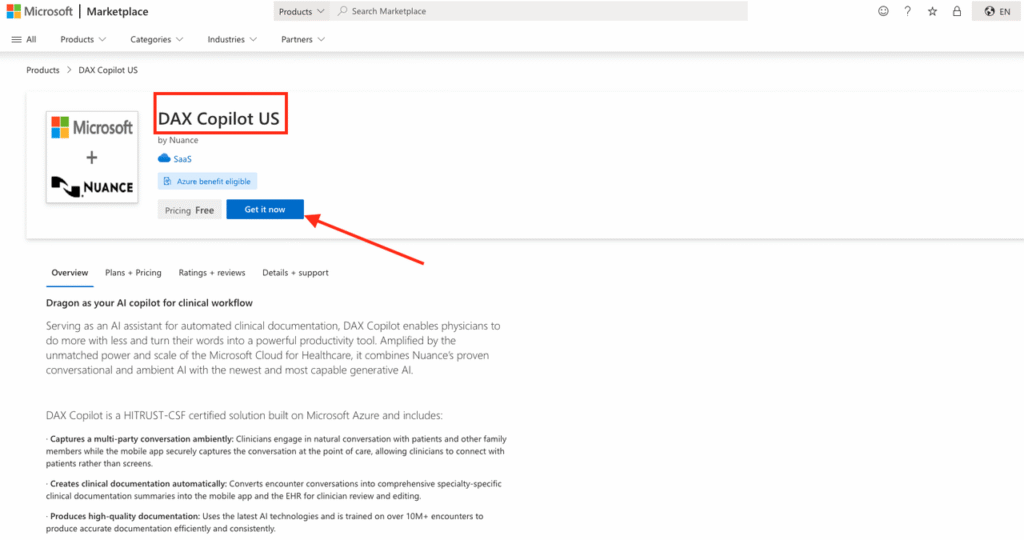
In live pilots I’ve participated in, clinicians often perceive DAX Copilot as:
- More “hands-off”: ambient listening during the visit, then a ready-to-review draft note.
- Tightly aligned with Dragon speech recognition UX: physicians already familiar with Dragon adapt quickly.
Nuance marketing claims coverage across many specialties, and in practice I’ve seen solid performance in:
- Internal medicine and family medicine
- Cardiology and orthopedics
- Some surgical clinics, especially where Dragon was already heavily used
It’s important to note that DAX Copilot is more of a SaaS product with configuration, not a raw building-block API like HealthScribe.
EHR Partnerships and Health System Ecosystem Strengths
Where DAX Copilot really flexes is EHR ecosystem integration:
- Deep partnership and integration work with Epic and other large EHRs (per 2024 coverage of Epic–Microsoft–Nuance collaborations).
- Marketplace presence and enterprise contracting via Microsoft and Nuance, which large IDNs already trust.
In a large Midwest health system I worked with, the main reason DAX Copilot won the RFP over homegrown AWS-based scribes wasn’t model accuracy, it was:
- Out-of-the-box Epic integration (smart phrases, note templates)
- Enterprise-grade deployment and support channels
- Alignment with their existing Microsoft 365 and Azure strategy
If you’re running Epic on-prem or in Azure, DAX Copilot usually faces fewer political and integration headwinds than a bespoke AWS solution.
Feature Comparison: AWS HealthScribe vs DAX for Clinical Documentation
Transcription Accuracy Across Specialties and Accents
Head-to-head accuracy numbers are hard to publish because both vendors iterate models frequently and NDAs are common. In my internal benchmarks (multi-specialty US clinics, 2024–2025):
- Base transcription: roughly comparable for mainstream US accents in quiet exam rooms.
- Noisier environments (ED, multi-talker): Nuance still holds a slight edge, likely due to Dragon’s long history with medical dictation.
- Non-US accents: both degrade, but Dragon-powered DAX Copilot typically recovers slightly better in real-world UK/Indian clinician accents.
For either platform, I’d strongly recommend running:
- Specialty-specific word error rate (WER) tests
- Accent-stratified benchmarks
- Hallucination/omission audits for key clinical entities
Quality of AI-Generated Notes (SOAP, HPI, Assessment)
HealthScribe:
- Generates modular artifacts (HPI summary, assessment/plan candidates, problem/med lists) that you then stitch into local templates.
- Tends to be conservative, sometimes under-specifying nuanced differential diagnoses.
- Easier to post-process and constrain because the output is structured plus free text.
DAX Copilot:
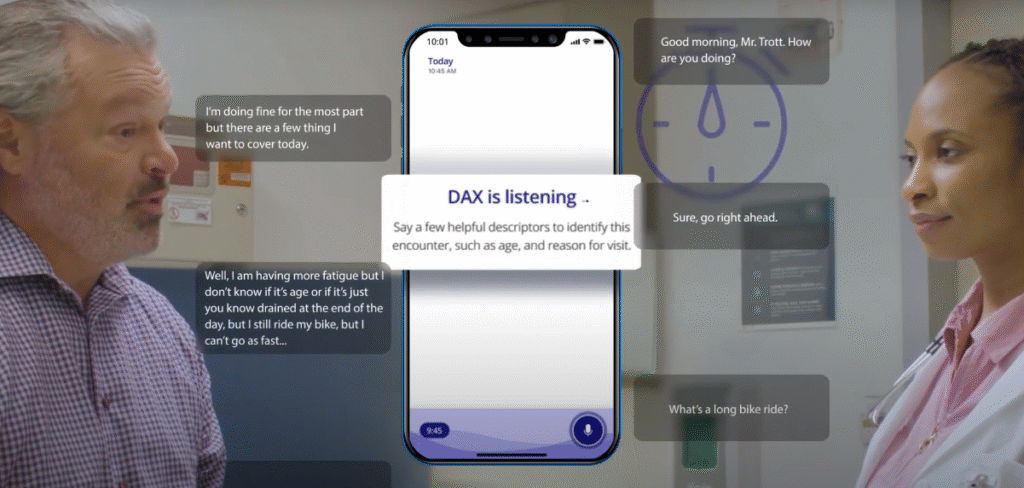
- Produces an end-to-end draft note that often feels closer to how clinicians actually write.
- Strong at stitching narrative HPIs and physical exams from free-flowing dialogue.
- More “opinionated” in style: requires good change-management so clinicians understand what’s AI-generated vs their own voice.
In cardiology follow-ups I’ve reviewed, DAX Copilot’s HPIs were more readable out of the box: HealthScribe’s were more modular and engineer-friendly.
Customization and Workflow Flexibility for Clinicians
If you want a heavily tailored, “your-EHR-only” workflow:
- HealthScribe gives you lower-level control via APIs and allows you to define your own note templates, summarization prompts (via your LLM layer), and validation rules.
- It’s ideal if you’re building a customized clinician UX or integrating into a non-mainstream EHR or custom FHIR stack.
If you want quasi-turnkey, especially in Epic or large enterprise EHRs:
- DAX Copilot offers configuration rather than full programmability. You gain speed-to-value but sacrifice some granular control.
- Good fit when clinicians are already living inside Dragon and Epic, and IT wants to avoid running custom AI infra.
Integration and Deployment: Evaluating Cloud Medical Scribe Fit
API, SDK, and Deployment Models (Cloud vs Embedded)
AWS HealthScribe:
- API-only service, invoked via standard AWS SDKs or HTTPS.
- Runs in AWS regions: you design the edge capture and any on-prem components.
- Fits nicely into Kubernetes-based microservices, Lambda workflows, and event-driven patterns.
Microsoft DAX Copilot:
- Delivered as a managed SaaS, not a general-purpose transcription/summarization API.
- For deeper customization you may layer Azure OpenAI / Microsoft 365 Copilot around it, but DAX itself is more product than platform.
If your team wants Terraform plans, CI/CD, and full observability over every step, HealthScribe is easier to treat like a microservice. DAX Copilot abstracts more away in exchange for a faster clinician-facing deployment.
EHR Compatibility and Integration Complexity
Key question I always ask: Where does the note eventually live, and who controls that interface?
- With HealthScribe, you build the bridge to Epic/Cerner/Allscripts yourself (or via an integration partner), usually via FHIR APIs, HL7, or custom import pipelines. More work, more control.
- With DAX Copilot, you lean on Nuance/Microsoft’s existing EHR connectors and implementation playbooks, especially for Epic. Less engineering, more vendor dependence.
For a 20-provider independent practice on a cloud EHR with weak APIs, I’d lean AWS HealthScribe plus a custom integration. For a 2,000-provider IDN on Epic with a big Microsoft spend, DAX Copilot usually wins the politics and the timeline.
Pricing Analysis for 2025 Cloud Medical Scribes
Cost Structures, Licensing Models, and Usage-Based Pricing
AWS HealthScribe (per public AWS pricing pages, late 2024):
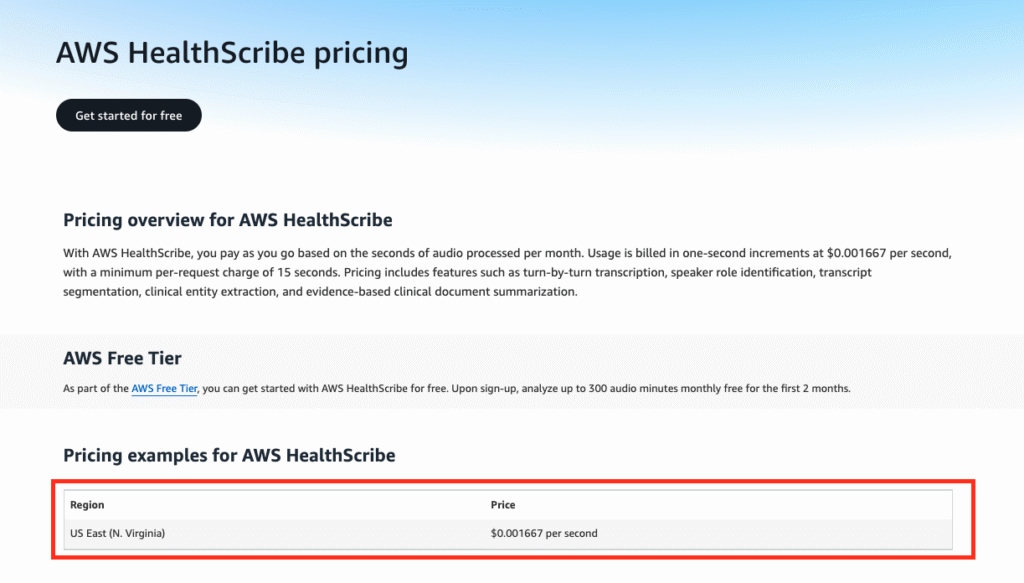
- Usage-based: charged per minute of audio processed.
- No per-clinician license from AWS itself: you layer your own margins or cost recovery.
- Easy to start small, but high-volume systems must watch aggregate minutes and storage.
Microsoft DAX Copilot (per Microsoft/Nuance marketplace and press coverage):
- Typically per-user (per-clinician) licensing, sometimes plus implementation fees.
- Enterprise contracts, often aligned with broader Microsoft 365/Azure deals.
- Less cost variability by minute, more by number of enrolled clinicians.
ROI Considerations for Clinics, Hospitals, and Health Systems
From a ROI standpoint, I usually model:
- Clinician time saved per note (minutes/encounter × encounters/day × salary).
- Reduction in after-hours charting (burnout, retention, harder to quantify but real).
- Scribe/Transcription spend displaced.
Patterns I’ve seen:
- Small and mid-sized practices with a technical partner often find HealthScribe cheaper in TCO, if they can amortize build costs.
- Large health systems frequently accept higher per-seat pricing for DAX Copilot because it shortens implementation and aligns with existing Microsoft contracts.
Either way, I always include hidden costs: change management, clinician training, QA of AI-generated notes, and ongoing governance.
Security and Compliance for Clinical AI Tools
HIPAA, PHI Handling, and Data Retention Policies
Both vendors position these offerings for HIPAA-regulated environments, but the threat models differ.
With AWS HealthScribe:
- You control VPC design, IAM roles, KMS keys, retention policies, and log redaction.
- PHI generally never leaves your AWS account except into managed services covered by the BAA.
- You must design and document your own data lifecycle (e.g., delete audio after X days, store transcripts Y years, etc.).
With DAX Copilot:
- Microsoft/Nuance operates the majority of the stack: you manage access and integration points.
- Data retention and residency policies are dictated largely by the DAX Copilot service and configuration.
- Microsoft 365 Copilot’s AI security framework provides enterprise-grade protections for data handling.
In both cases, I recommend:
- Running a formal security review and DPIA.
- Verifying no training on customer PHI without explicit agreements.
- Testing for redaction of incidental identifiers in logs and telemetry.
Enterprise-Grade Governance, Audit Controls, and Access Management
On AWS, HealthScribe benefits from the broader AWS governance ecosystem:
- IAM, AWS Organizations, SCPs, CloudTrail, Config, and GuardDuty all help enforce least privilege and audit.
- You can integrate HealthScribe usage with SIEM tooling easily.
On the Microsoft side, DAX Copilot rides alongside Azure AD / Entra ID, Microsoft 365 security, and Nuance enterprise controls:
- Centralized identity, conditional access, and MFA for clinicians.
- Audit trails inside EHR and DAX portals to track who edited/accepted AI-generated notes.
Neither solution removes your responsibility to carry out clinical safety nets: mandatory clinician review, no auto-signing of AI notes, and clear labeling that content was AI-assisted.
Which One Should You Choose? AWS HealthScribe vs Microsoft DAX Copilot
If I strip away the marketing, here’s how I personally frame it for teams in 2025:
Choose AWS HealthScribe if you:
- Have strong internal engineering/DevOps and want an API-first, cloud-native building block.
- Need deep customization, non-standard workflows, or integration into custom EHRs/FHIR platforms.
- Are already all-in on AWS and comfortable owning the safety, QA, and UX layers yourself.
- Want to explore HealthScribe’s features for custom implementations.
Choose Microsoft DAX Copilot if you:
- Are a large health system on Epic or another major EHR with existing Nuance/Microsoft relationships.
- Want faster clinical adoption with a productized, ambient documentation experience.
- Prefer enterprise licensing, vendor-led implementations, and less custom code.
In practice, I’ve even seen hybrid patterns: DAX Copilot for high-volume outpatient clinics, and a HealthScribe-based stack for telehealth or niche service lines.
Whatever you choose, treat ambient documentation as a clinical safety–critical system, not a convenience feature. Run prospective pilots, benchmark hallucination and omission rates, include risk mitigations in your design, and make sure every note remains clinician-owned.
Whether you choose AWS HealthScribe or Microsoft DAX Copilot, ambient documentation often requires custom post-processing and specialized medical models. dr7.ai offers a HIPAA-ready unified API with free access to leading models like MedGemma—start prototyping today.
Disclaimer: The content on this website is for informational and educational purposes only and is intended to help readers understand AI technologies used in healthcare settings. It does not provide medical advice, diagnosis, treatment, or clinical guidance. Any medical decisions must be made by qualified healthcare professionals. AI models, tools, or workflows described here are assistive technologies, not substitutes for professional medical judgment. Deployment of any AI system in real clinical environments requires institutional approval, regulatory and legal review, data privacy compliance (e.g., HIPAA/GDPR), and oversight by licensed medical personnel. DR7.ai and its authors assume no responsibility for actions taken based on this content.
Frequently Asked Questions
What is the main difference between AWS HealthScribe and Microsoft DAX Copilot?
AWS HealthScribe is an API-first, HIPAA-eligible medical scribe service you integrate into your own apps and EHR workflows. Microsoft DAX Copilot is a Nuance-powered, productized ambient clinical documentation solution that ships with workflow, UI, and deep Epic/EHR integrations, but offers less low-level programmability than HealthScribe.
When should a health system choose AWS HealthScribe vs Microsoft DAX Copilot?
Use AWS HealthScribe if you have strong engineering/DevOps, want deep customization, or need to integrate with custom EHRs/FHIR stacks in AWS. Choose Microsoft DAX Copilot if you’re an Epic‑heavy or large enterprise with existing Microsoft/Nuance relationships and want faster, more turnkey ambient documentation deployment.
How do pricing models differ between AWS HealthScribe and Microsoft DAX Copilot?
AWS HealthScribe typically charges per minute of audio processed, with no per-clinician license from AWS. Microsoft DAX Copilot is usually sold on a per-user (per-clinician) license with possible implementation fees, often bundled into broader Microsoft 365 or Azure enterprise agreements for large health systems.
Which offers better transcription accuracy and note quality: AWS HealthScribe or DAX Copilot?
In internal benchmarks cited, base transcription accuracy for mainstream US accents is roughly comparable. Nuance/DAX Copilot often performs slightly better in noisy settings and some non-US accents, and its narrative notes feel more “clinician-like,” while HealthScribe outputs more modular, structured artifacts that are easier for engineers to post-process and constrain.
Can AWS HealthScribe or Microsoft DAX Copilot be used for non‑US languages and international deployments?
AWS HealthScribe is currently optimized for US clinical English and common outpatient workflows, so international or non‑English use cases may require custom pipelines or other AWS services. DAX Copilot primarily targets English-speaking markets; for broader language coverage, organizations often pair local dictation or regional speech models with regional EHR and compliance requirements.
Past Review: